
Its that time again, as 2025 is an ‘odd’ year it is possible that we may see the return of Pink salmon (Oncorhynchus gorbuscha) to the Ness system.
Background Information
The species is native to Pacific and Arctic waters, from the Sacramento River in northern California to the Mackenzie River in Canada; and from the Lena River in Siberia to Korea and Honshu in Japan. They were introduced to some Russian rivers in the Barent and White Sea areas between the 1960s and 1990s. They have slowly spread westwards and have now colonised some northern Norwegian rivers where self-sustaining populations have now established. Small numbers of pink salmon have turned up in UK rivers for several decades. The impacts of a spawning pink salmon population on the native species within our waters are currently unknown but may include competition for resources both in freshwater and marine areas.
Pink salmon have a two-year life cycle, and both males and females die after spawning. After hatching the juveniles migrate relatively quickly to the sea. They then spend the next year feeding on crustaceans and fish, and during the second summer they return to freshwater to spawn and complete their lifecycle. Fish that spawn in odd-numbered years have offspring that also spawn in odd-numbered years, and consequently they do not spawn with fish that spawn in even-numbered years. The odd-number-year population is most numerous, but there is also a smaller population of even-number-year fish.
In 2017 unprecedented numbers of Pink salmon were captured in Scotland. A similar situation was observed in 2019 and 2021, and in the same years Pink salmon were also reported in Norway, Finland, Iceland, Denmark and Germany. Pink salmon are not native to Scotland and are likely to have ‘strayed’ from some of the rivers in northern Norway or Russia.
On the Ness six fish were captured by rod and line in 2017, however numerous fish were observed. These sightings were further confirmed by deploying in river cameras, the first female observed was on the 8th August with a male recorded on 10th August. Spawning activity was recorded on 11th August with fertilisation occurring on the 14th.
 No further spawning activity was recorded after the 14th August, although redds were observed in the vicinity of the camera locations. Females were also observed exhibiting territorial behaviour on the redds. Pink salmon redds distinctively circular in nature and no overlap and is likely due to territorial nature of females.

A number of redds were raked in an attempt to recover eggs and to determine whether they would actually hatch into viable offspring. These eggs were placed in incubation chambers and monitored. They hatched on 23rd September and the alevins began turning silver on 25th October. This obviously suggested that Pink salmon are able to successfully spawn in Scottish waters. On the 15th November 2017 we found that none of the fish had gone on to survive to the point of emergence (when they swim up from the gravel). Despite the mortalities experienced in the incubation boxes, we believed it was likely that at least a small proportion of pink salmon contained in natural ‘redds’ in the River Ness will go on to emerge. It seems that this may occur earlier than it would in their natural range (November/December rather than April/May). This may reduce their chances of survival in the marine environment.

A total of 378 Pink salmon have been reported since 2017, so far this year two have been captured on the Tweed.
So what are we doing?
The NDSFB are currently monitoring the situation. We intend to carry out EDNA surveys on the River Ness. This involves the filtering of water taken from a number of sites on the river. Water is pumped through a sylphium cartridge and the sample sent for analysis. In addition, accoustic microphones are in place at previous spawning locations, it is hoped these will record fish cutting redds. NDSFB board staff are licenced to capture pink salmon when required.
How can you help?
Fisheries Management Scotland have produced an advisory note regarding Pacific pink salmon which may make a return to Scottish waters this year.
Please be aware that in Scotland under the Wildlife and Countryside Act 1981, Pink salmon of the species Oncorhynchus gorbuscha are an invasive non-native species. The 1981 Act makes it an offence to fish for and retain Pink salmon (i.e. have one in your possession or under your control).
However, if a pink salmon is caught accidentally whilst fishing legally for other species, although it is technically an offence, a defence of due diligence may be established if it can be shown that best practice was followed. Please see the advisory note to learn what should be done if you capture a pink salmon. https://fms.scot/pink-salmon-in-scotland/
Identification
Pacific pink salmon, when fresh from the sea, are steel blue to blue-green on their backs, silver on the flanks and white on their bellies.

There are large black spots on the backs, upper flanks, adipose fins and tail, some of the spots on the tail can be as large as the fish’s eyes. They are very uniform in size, reaching only 40 to 60cms in length. It is possible that at first sight, a fresh pink salmon may be confused with a small Atlantic salmon. A key feature is a dark/black tongue/mouth.
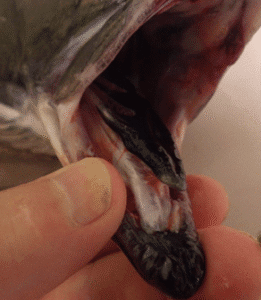

Breeding males are immediately identifiable because of their humps and they will almost certainly be running milt at this time of year. Their black tongues and heavily spotted tails are also very obvious. Females will show heavily spotted tails and be pinkish-brown on the flanks.


If you are confident that you have captured a pacific pink salmon the fish should be humanely despatched and retained. If you have killed and retained a pink salmon, please immediately contact the relevant district salmon fishery board, who will arrange for further inspection and analysis, if necessary. A simple reporting app has been developed to record key information on fish observed or caught, including the ability to upload images and record the location. Pink salmon which have been observed, and not caught, and also any dead fish should also be recorded on the app. https://survey123.arcgis.com/share/1b8632f1d06c48c89bbac8901d084346
Please be vigilant for any early or unusual spawning activity – particularly during August and September, when any pink salmon present are likely to be active in spawning areas – shallow, gravelly glides and runs. Any suspected activity should be reported as above.